Showing posts with label gear. Show all posts

Hey Little Dude


The Ovation "Little Dude" was a failure of a marketing name for more than one reason - The first of which was the fact it wasn't so little. I recall mine weighing a small ton. Of course it didn't help that one of the handles had come off and the thing was covered in slippery black leather and was extremely awkward to carry. Of course I shouldn't be too unkind. It was made in the era of poor PA systems so a guy needed a huge amp just to be heard in any sort of decent sized club.

Still, what were they thinking when they came up with the name? Granted this ad is from 1970 so perhaps they thought hippies would find the name comforting. Frankly I can see it causing more problems than not. Imagine you're playing a gig and the guitarist from the opening band comes up.

"Dude, I dig your amp. What is it?"

"You mean this Little Dude?"

"Yeah"

Awkward silence reigns until the first guitarist asks again. "But like what kind of amp is it?"

"I told you. It's a Little Dude."

"Yeah, funny man. Look, if you don't wanna tell me it's fine. Just because you're the headliner doesn't mean you can screw me around okay? I was just asking a "f*ckin friendly question!"

You'll lose more potential friends with these amps, but get a great reputation about being secretive with your gear.

But back to my personal story. I got this amp in early to mid 80s the same time I got the Raven SG pictured on the right. They both came from a pawn shop that was operated by two men nearing their 70s who were the biggest characters I ever met - and probably the biggest rip-off artists.
They told me this was a tube amp - which it wasn't, but to demonstrate the tone, one guy plugged in the guitar cranked it up and started wailing away on some Clapton licks. The sight of this old geezer tearing it up on a hundred watt amp at nearly full volume with sound pressure levels high enough to shake the windows made me want to buy it. I think I paid about $200 for it, which in 1980s dollars was probably more than it was worth, as they go for about the same price now. Ovation only made these for 2 years before abandoning them. Perhaps the name put people off.

That amp never sounded quite as good as it did in the pawnshop. First of all, I could never turn it up to it's "sweet-spot" in my parent's house or my first small apartment. Early transistor amps like this one are likely what gave solid state a bad rap in the guitar amp department. Most of the time I played it, it was cold and lifeless sounding. Of course, I could barely play back then so it could have been me.

Still, the thing looked cool. The black leather covering was neat. It often did in a pinch as an extra chair or table when needed. And it had it's own reverb tank so if you bumped into it, it made a massive crashing sound.

Unfortunately, I went through a phase between university and my first few years of work where I moved 13 times in 10 years. I also lived in several 3 and 4 floor walk-ups. After schlepping this thing through a couple of moves I left it at a friends house for a few years, where it got loaned out to another friend then slowly vanished along with the SG guitar.


The Irresistable Lure of Brian Jones' Teardrop Guitar

An enigmatic man needs and enigmatic guitar. No one knew this more than ex-Rolling Stone Brian Jones.

At the beginning, leader of men - notably Keith, Mick, Bill and Charlie. Originally the Stones were Brian's band. However, when manager Andrew Loog-Oldham started locking Mick and Keith into empty rooms with their guitars to create a hit songwriting duo, Brian became the odd-man out.

For a while, before drugs and his backyard pool took an end to his life, Brian was still the fashionable figurehead of the band. The Stone with style. And no more so was that evident in his choice of the Vox Teardrop guitar. This has to be one of the sexiest pieces of modern design ever conceived. Simple black on white. Male and female shapes. In many ways the yin and yang of electric guitars.

I always wanted one, but the originals are rare and are well beyond my wallet. Thankfully Phantom Guitars in Oregon makes a relatively affordable copy and I was lucky enough to find a used one on Ebay for an even more affordable price.


Here's the one I bought. Very similar to Brian's original. The knobs were slightly different (white plastic instead of metal) but otherwise an incredibly faithful visual reproduction. The finish was top-notch. These guitars play like a dream. The round shape feels comfortable against the body, the neck feels great and they are beautifully balanced. Holding one of these will also guarantee you'll stand out on any stage or bandstand.

If you are sensing a BUT here, you are right. I loved everything about this guitar except the sound. The sound was definitely thin. Well the guitar has narrow single coil pickups so that was to be expected. There's always a trade-off between thin and bright right? Not here. Not only was the sound thin but it lacked any brightness at all.

I was tempted to see if I could find new pickups for it even though they were an oddball rectangle design. However, I wasn't sure that was the problem. I think it was more likely a lack of good string tension. The strings merely passed through the back of the bridge rather than through the body (such as on a Telecaster or Strat) I could have tried to get someone to custom make me a new bridge but that seemed a lot of work since I couldn't guarantee it would solve the problem.

Reluctantly, I traded it in when I bought my next piece of gear. It's too bad. Looking back I should have had more photos taken of me playing it. Of course, I could never be quite as cool as Brian Jones.


GEAR - The Raven SG circa 1970s


Sometimes it is not until we get older that we appreciate certain things. That's certainly the case with the guitar I'm about to talk about. When I was a teenager I wanted a Les Paul badly, but even a relatively inexpensive copy was hard to come by for under $300 in those days. Knowing I didn't really like my Strat, I went to a pawn shop to get another guitar and amp. The guitar I came out with was this Raven SG copy.

From the research I've done it seems like Raven's were made in the Far East for the Canadian market. While a budget brand, they were well made. Even though I was far from knowledgeable about such things at the time, looking back I recall the guitar had pretty decent action and was relatively well set up and easy to play.

As I gaze at the photo, I'm struck by just how cool a guitar this was. Neck and headstock binding and block inlays starting at the first fret gave it a very upscale look. Then there's the obvious aftermarket pickup upgrade in the bridge. When played wide open on a small tube amp this thing probably roared. Too bad I was using it on a big transistorized beast, but I'll get more into that on another post.

Of course the tastiest part of this whole guitar lies behind the bridge with a Bigsby style vibrato unit (or whammy bar as we used to call it back in the old days). I've never seen a Bigsby on Gibson SG and I have no idea if this sweet piece of hardware came stock on this copy-guitar or was installed afterwards like the pickup.

These Bigsby style units only have a semi-tone worth of give - which really wouldn't cut it for 80s hair metal playing - but they have a very sweet sound when used properly. The major drawback of the hardware is its heaviness but on a light SG it works perfectly to balance the guitar and keep it from being neck heavy.

So what happened to this instrument? Well after learning basic major and minor chords and little else I gave up on the guitar. I moved a few times and the massive amp I had was really getting in the way. I left the amp and guitar in a friend's basement and years went by without me asking for it back. Eventually it was loaned to another friend and from there it disappeared. Now that I can play better, I often wish I had it back even for an afternoon to take it out for a run and see just what it could do.

GEAR - The allure of the White Stratocaster


In a previous post, I told you all about my first guitar - a catalogue grade plunker that I returned so I could get a better instrument at the guitar store. And this is the instrument. A Harmony Stratocaster copy circa late 70s.


To tell you the truth, I still wasn't entirely happy with this guitar either. You have to remember this was the early 1980s and everyone was playing what later became known as hair metal. The guitars of choice were Super-Strats with high gain pickups and the popular guitar colors ranged from bright red to lime green and banana yellow.


And what of this thing before me? Without even thinking about how it sounded my eyes were already disappointed by it's drab look. It was technically "white" but in reality white on a Strat - even most copies - is a dull beige. Why were they even selling guitars in this color? Well of course now I know. Jimi with an "i" played one of these, and he played it on film in concert movies such as Woodstock. Drab as it is, this color is associated with the magical creativity of one man.


Does that mean the guitar plays any better? Ummm no. It's all poppycock (as the British say) really. If spending half a million on a 1959 Les Paul isn't going to make you sound like Jimmy Page, having a white Strat certainly won't make you sound like Hendrix.


Of course, THIS guitar isn't even a real Strat. It's a Japanese copy. Even so, its pickups were bright and weak just like a regular Fender model. And that's really not a great thing when you're trying to play Van Halen riffs through the 100-Watt solid-state amp which can be glimpsed behind the guitar. The sound coming out of there was cold and lifeless. I eventually bought a distortion pedal which made things sound a little better but it still wasn't inspiring.


What else was wrong? Compared to the guitars I have now, the action was incredibly high. For fingers not used to playing, it was painful. I knew enough to adjust the action by fiddling with the tiny screws on each string saddle, but never had the courage to try to adjust the truss rod (which is probably what it needed). It was also a makeshift hardtail Strat. It looked like the whammy-bar had been broken off by the previous owner but either he or the guitar tech had done a pretty good job in adjusting the bridge piece so there wasn't a lot of give.
I never quite liked the maple fingerboard either. The thick varnish they used on it didn't give a very good feel to the guitar when I played it. The one thing I did like was the headstock. A bit smaller and less round on the end than the Fender's, I still prefer it visually to the real strat.


After several years of storage, I ended up giving it to a friend. After getting another Strat copy later in life (a Tokai), I ended doing the same with it. I'm not sure why, but I don' t really like Strats. Perhaps because I've never played a real Fender version.


Actually I think it's more to to do with the scale length as well as they way it sounds. Or maybe I haven't spent enough time trying to coax the magic out of those single coil pickups. The Strat is the world's most popular guitar. There must be a reason - and not just the color of the paint.

GEAR - The Beautiful Simplicity of PRS SE One guitar


In the world of Rock and Roll, simpler is often better. In the 1950s, what made Rock and Roll different from other popular music was both the small size of the band (often a trio) and the raw simplicity of the music. So it's no surprise that simple, but well made guitars and amplifiers have been a staple of the genre since almost day one.
The PRS SE One guitar at left is the perfect example of stripped down functionality at its best. It's based on the Gibson Les Paul Junior design which was originally made as a student guitar but caught on with many pro players from Leslie West to Billie Joe Armstrong.
The PRS SE One has a similar pedigree. The SE stands for Student Edition and boasts a relatively budget price. Don't let that fool you however - despite being half the cost of a similar Gibson, the PRS sports several design improvements. The lower cutaway is sculpted for easier access to the higher frets, while the back is slightly contoured to your body so it doesn't dig into your ribs.
Another difference is the scale. At 25 inches, it's a little longer than the Gibson which gives it slightly more string tension and a bit of a snappier sound. The action is also less rubbery if you prefer light strings such as .09s. It also has a wrapover bridge and a soapbar pickup which has that fat, toneful and slightly ragged sound that's typical of the design.
The neck is one of the most comfortable I have played and once you pick it up, it's hard to put down. But perhaps the thing I like most is what it doesn't have. Rather than separate volume and tone controls it only has one knob - volume. Like most electric guitars however, lowering the volume also bleeds off some of the treble so it's a tone control as well - plus it responds to the dynamic nature of your playing. Here's a short clip of me improvising some blues on it through a Fender Pro Jr. amp


In the darkness of a club if you want to adjust your volume or tone you have to quickly select one of as many as four knobs - not an easy feat when you're playing. With only one knob to worry about it's a lot easier to use. And there's good reason to use it. The volume knob gives you a host of options in a cranked amp. Set up a good distorted lead tone on 10, then roll the volume back to give yourself a nice crunch or clean sound.

Here's an example. In this short video I start off with the volume on 1, and do a near clean verse of Sweet Home Alabama. I notch it up to 5 for a great AC/DC sound, then up to 10 for some hairy, distorted Neil Young.


Contrast the SE One to this feature-full but mind boggling old Harmony below and you can imagine which is easier to change on the fly.

The PRS SE One is not only a great guitar for the money, it's a great guitar - period. While it's made in Asia to keep the price down, its playability ranks up with any professional guitar I've picked up.

GEAR - The Bizzare story of The Shaggs model Avalon guitar

Ever since Les Paul signed the first major endorsement deal for a solid body guitar, anyone who's ever strapped on a six-string has dreamt that one day they will have a particular guitar that will bear their name.

Most of the time this happens when a popular guitarist signs a deal with a corporate instrument manufacturer, but sometimes an artist just becomes so associated with a particular model that it gains their name. So is the case with the Avalon Shaggs model, seen played by Dot and Betty Wiggins of The Shaggs.


These shaggy-haired girls (hence the unfortunate band name) are arguably the most bizarre musical success story of all time. The group consisted of the three (eventually four) Wiggins sisters from New Hampshire.

Apparently, their father was told by a fortune teller that his daughters would form a band and become famous. Withdrawing them from school and forcing them to take vocal and music lessons, Austin Wiggins eventually payed for them to record the above album. Of the one thousand copies that were pressed, only one hundred were every officially distributed.

In the pre-YouTube age, even a cult following was unlikely, but somehow a copy of the album may its way into Frank Zappa's hands. Frank promptly declared they were better than the Beatles and were his third favorite band of all time. As to their music, it has been described as fresh, naive, creepy, melancholy, brilliant and terrible. Frankly, there is absolutely no way to describe The Shaggs music so I've uploaded a video courtesy of YouTube member hoglevid. You must play it to believe it.


Okay, I'll give you a minute to recover from that song. You may be thinking the same thing I am - they had music lessons? The second thing that comes into my mind as I hear their music is the poor engineer who recorded it. What was he thinking? I just picture some old guy with a crew cut and a polite smile - his eyes glued to the recording levels trying desperately to focus on anything but that sound coming through his headphones. At some point, I picture his mind giving up and him thinking - "Please, someone just shoot me!"

Now back to the gear. The Avalon guitars, which were made in the late 60s, are still a bit of an enigma. They're likely of Japanese origin given the over-curved cutaways and headstock. The Japanese companies of the 1960s and 1970s loved this style as they were reminiscent of Moserite guitars which were played by the most popular American band ever in Japan - The Ventures. The guitar could also have been inspired by the Burns Bison


Makers of catalogue grade musical equipment often sold similar gear under different brand names. As to the Avalon brand however no one knows exactly which company made them.

I have heard mixed reviews on these guitars. Some consider them terrible, while others love them. Considering the girls could afford upscale Gibson and Fender amps, this off-brand seems an odd choice. However, when one considers that that Avalon featured a bass done in exactly the same design - the choice of guitar becomes clear. I can picture Austin Wiggins - the girl's father - choosing these instruments for their visual symmetry. This was obviously important to him as the the girls usually dressed alike.


The group's cult popularity, when added to the fact that no one else of any consequence ever played these bizarre looking Avalon instruments, have made the group synonymous with this brand of gear. Both the bass and the guitar are now known to collectors as Shaggs models.

How do they sound un-Shagged?I got this clip from YouTube member Terser, who was able to find a beat up but otherwise intact version of the Avalon


Much and all as I may make fun of The Shaggs music, one thing is clear - they will enjoy a musical place in history and a popularity that I'll certainly never attain. And what's the likelihood that there will ever be a guitar that the world associates with me?

GEAR - More Cheap Plastic Amp in Action

I haven't posted much lately as I've been recovering from a nasty cold. In the meantime here's a little something I put together a couple weeks ago when I was experimenting with recording my cheap Harmony amp from the early 80s. Cheap little amps can sometimes record surprisingly well. I didn't spend a lot of time composing this and most of the parts were done in one take. Still... it doesn't sound too bad.

GEAR - Early 1980s Harmony Plastic 5-watt practice amp


In my last gear post, I told you about my very first guitar which I bought in the early 1980s. That guitar is long gone, but oddly enough the cheap plastic transistorized amp I bought with it from Consumer's Distributing is still in my possession.


The amplifier itself has absolutely no make or model designation printed on it anywhere. I assume it's a Harmony, because the power cord that came with it is imprinted with the Harmony logo. The cord can be detached and the amplifier can run on 6 batteries which I think are "C' batteries. Does anything even use C batteries anymore? Okay okay, maybe a couple of things but lets keep it clean here.

Back to the amplifier. I can't remember how many watts it actually puts out, but I'd think 3 to 5 watts maximum - and transistor watts at that. A half watt tube amp could blow this baby right out of the water and throw it into a tree.


The amp features a bright and normal input as well as a volume and tone control. It also offers a 1/4 inch headphone jack. I decided to open it up for the first time and noticed it has a 5w 4 ohm speaker. There are a handful of other small components mounted on a PCB and that's it - pure catalogue-store, grade-z amp!


Why did I keep this cheap plastic thing? Well it never took up much room. More importantly, it's incredibly light. The speaker magnet probably weighs close to a pound, and the rest of the amp probably weighs in at less than half that. It's a model of simplicity. The plastic doesn't exactly have the resonance of a nice speaker cabinet but the thing sounds pretty woolly when it's cranked up. One thing I love about it is that it's SO underpowered, it precludes the need of having a distortion or overdrive pedal to switch from clean to dirty. So with all due respect to Jimmy Page, here's an example of what this amp can do on it's own with absolutely no effects whatsoever.


For more gear related postings go here.

GEAR- My first guitar. Or Life Lesson #7 - choose quality


My first guitar was purchased at the ubiquitous Consumer's Distributing chain of catalogue stores. Anyone in Canada of my age remembers Consumers (as we called it). They were kind of like Sears only without the clothing. They sold small appliances, jewellery, electronics, sports equipment and toys.
This description partially sums up the buying experience.
Consumers Distributing aimed to reduce costs for customers by storing goods in a stockroom, instead of displaying them in a costly showroom. Customers made their selections from a catalogue, filled out a slip with product identification, and waited for staff to retrieve the items from the warehouse.
Of course half the time the stuff you wanted was not in stock that day and if it wasn't in stock that day you likely weren't going to get it EVER because a check of their main warehouse would always prove fruitless.
"Oh by the way," the woman behind the counter would say. "We have a similar product here at 5 times the cost of the one you wanted. It's definitely in stock. Would you like to buy it instead?"
"Would you like to be jailed for bait-and-switch-style fraud?" I would say in my precocious 13-year old way.
They never liked me much there. I'm sure they called me names as soon I left the store.
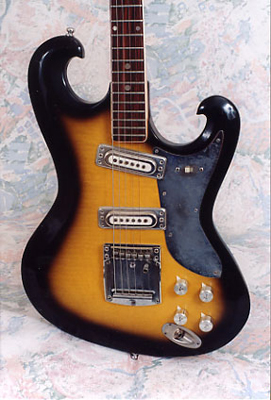
On this day though the guitar was in stock, and it was exactly like the guitar pictured here.
What kind was it? It was definitely a Japanse guitar. But it had no name of course. The one pictured here is identified as a Teisco, however by the early 80s Teisco had long been bought out by Kawai, so it may technically been a Kawai. Japan was making some very cool guitars at the time, This was not one of them
I wish I could say more about what the guitar felt like to play or what it sounded like. All I can remember was that it wasn't quite what I expected (a feeling that was eerily similar to what I'd felt every other time I bought anything from Consumers)
I also bought a cheap plastic amplifier with it. Actually I still have that amp and will feature it in my next blog post.
I bought the guitar for about 70 dollars (not an inconsequential sum back then). I had no idea how to play it or even tune it. I took it to the music store to get the guy to tune it up for me. He looked at me and said for the money I had spent I could have gotten a much better guitar from his store.
He pointed to a Harmony Stratocaster copy hanging from one of the racks and said that it was the same price. Later that night i took the catalogue guitar back to the store and got my refund. The following day i went back to get the Strat.
Oh, that catalogue guitar is now "vintage" and would probably cost about $200 in good condition. Adjusted for inflation that's about $40 more than I paid for it. This guy thinks people are paying way too much for these guitars now. I agree.